Showing posts with label Old methods. Show all posts

Tuesday, 17 February 2015

Bobbins

     Turning Bobbins in the style of those found on the Mary Rose

The Bobbins and related artifacts.
       The Mary Rose presents an amazing snapshot of life at the time it sank. The quantity of well preserved artifacts provides us with examples  of  items which we can recreate.
Having recently acquired a lathe I decided that I would like to make a series of small objects, mostly because I get immense enjoyment  from wood, but also with an eye to sell some if they are  up to scratch.
   The collection of thread Bobbins from the Mary rose are ideal subjects for this, being relatively small and quite simple.

The Bobbins:

Four bobbins: Material         Length (mm)  Diameter (mm)
                     Ash                   128                    28
                    Willow                115               25 (stem)   40 (Collar)
                     Alder                 37                       12  (this is an incomplete fragment)
                     Scots pine         95                       17    This one is the conical one in the picture.

                      Measurements taken from

They have three collars, one at either end, plus one in the center, allowing for two colours or type of thread to be shown/ stored.
In addition the core has been hollowed and stoppered creating a space to store needles. at least one of the bobbins was still stoppered and contained needles.


My first attempt

More care is needed in drilling the needle compartment
This was just a freehand attempt to make something in the approximate style from spare bits of Poplar.

Overall I'm quite happy with this Bobbin as a quick experiment.


The hole made by drilling at an angle rather than vertically.

Sunday, 9 March 2014

WHEELBARROWS


Part 1 

History and Types of Wheelbarrow


Festival is coming. For many years I have thought about making a barrow to move gear around, to carry goods to the market, to loan to fighters and quite possibly so that I can use one after dinner each night just like this :
This Barrow is a flatbed type with a box built above the bed/handles. It also fits the rustic stereotype of a  wooden wheelbarow : A glutton, a book of hours (PML M.1175, fol. 191r), c. 1525-1530 Bruges, Belgium
.
  But mainly I want one because Wheelbarrows are cool.  So here is part one of the research process, finding images and background information on the wheelbarrows of medieval Europe.

Wheelbarrows are known from at least the 1st century BC in China (Lewis 1994). however our first solid piece of evidence for the wheelbarrow in Medieval Europe comes from the  building accounts of King Henry III around 1222 A.d and concerns the purchase of eight wheel barrows to be used in the Kings works at Dover (Matthies 1991). Handbarrows which are essentially a stretcher appear to have remained popular for some time, despite an increase in the pictorial and financial evidence for the Use of wheelbarrows in Europe (Matthies 1991). Wheelbarrows in England were around 6 times the price of handbarrows, possibly a disincentive for their use.

This image from around 1250 A.d shows both a "handbarrow" or stretcher and a Wheelbarrow. (Vitae Offarum, Trinity College Library, Dublin MS 177

Wheelbarrows while varying widely in design can be split into 2 main types.
A crippled child on a flat wheelbarrow, the barrow pusher has a strap around his neck to help support the weight the Luttrell Psalter (British Library Add. 42130, fol. 186v), c. 1325-1340 Also Giant duck!!

  •   Flat bed wheelbarrows resembling the original handbarrows in that a flat surface created by the two handles create the basis of the barrow and support the load.
Detail from  the Berner Chronik 15th Century (MS Hist Helv I 16, fol. 35r, Stadtbibliothek, Bern), showing a wagon or box style wheelbarrow with a solid rather than spoked wheel.
  • Wagon/box bodied wheel barrows which have a box built into the barrow as a load holder. Some of these Barrows have solid wheels.

More of a  2 wheeled cart than a wheel barrow..... But check out those boots !!  Salvaging from the ashes, Konzil von Konstanz (ÖNB 3044, fol. 82r), c. 1465-1475

Dutch Market Scene C1550 Pieter Aertsen. Note the strap over the Barrow pushers shoulders.

What next?....

I intend to make a couple of Wheelbarrows, providing I can find someone to take them to festival for me. Hopefully I will have a post detailing my decisions regarding style, material and design and then another showing  construction. Hopefully! 

I will also be consulting this site quite a bit Building a 16th Century wheelbarrow

References

  •   Matthies A. 1991 "The Medieval Wheelbarrow" Technology and Culture Vol. 32, No. 2, Part 1  pp. 356-364    Published by: The Johns Hopkins University Press: Available through JSTOR database which is available to Australian National library card holders online at no cost.

Friday, 24 January 2014

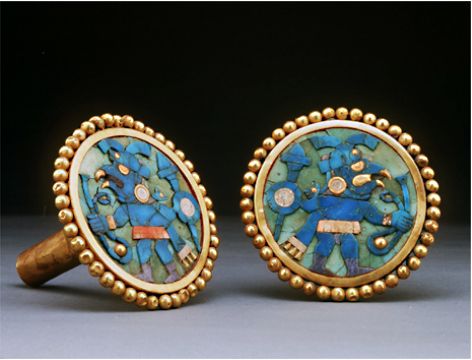
PRE-INCAN TEXTILES, SERIOUSLY COOLER THAN THE GOLD!


Today I went to see the National Gallery of Australia exhibition  Gold and the Incas: lost worlds of Peru . I expected to enjoy it, I expected to see ritual golden artifacts and a few other items. I wasn't prepared for the exquisite textiles and ceramics.

These pictures, while not all from the exhibition do give you an idea of what to expect.
CHUQUIBAMBA culture Southern highlands 1000 – 1475 AD
Textile length with 'tocapus' pattern 1000-1475 AD wool , tapestry weave
218.8 (h) x 91.2 (w) cm National Gallery of Australia, Canberra NGA 1981.1089


Moche
North coast, Peru

Portrait Vessel of a Ruler, 100 B.C./A.D. 500
Ceramic and pigment
35.6 x 24.1 cm (14 x 9 1/2 in.)
     
Mantle border fragment, 1st–2nd century Peru; Nazca Cotton, camelid hair; L. 41 3/8 in. (105 cm)  
CHANCAY culture Central coast 1200 – 1450 AD
Open-work textile with fish design 1200-1450 AD cotton
105.0 (h) x 96.0 (w) cm 


If you get the chance see it. I'm going to and find out more about these Peruvian cultures.

Thursday, 19 September 2013

Carved wooden Bowls: in search of a style


I want to carve some relatively simple wooden bowls, and since my "audience" is the SCA I really need to find an appropriate style from before 1600 a..d

This is not the only reason of course, or even the main one. Trying and learning different styles will be fun and teach me more about the craft.  This will of course remain a work in progress.

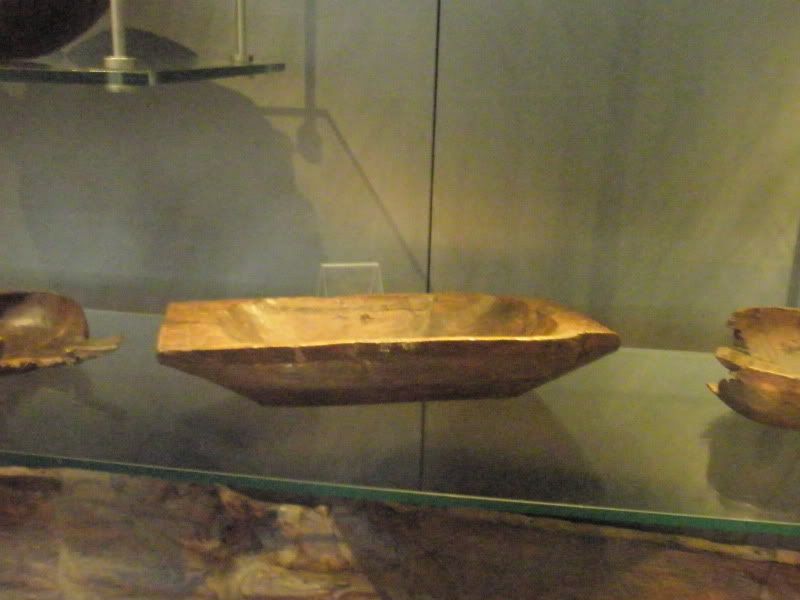
The Oseberg Ship Grave wooden household artifacts ( C 834  a.d)

"kitchen utensils include four wooden trays, two whole and two fragmentary, two large cauldrons
with chains and an iron tripod to put over the fire, three barrels for storage of food and liquid, a frying pan, a set of variously sized troughs for flour and bread production, five wooden ladles, two bowls.."
 From the Viking Age Queen, an article by Kirsten Ruffoni.
The images below are from Pinterest, I had trouble finding the original sites. The lack of scale is also an issue, however I will be able to copy proportions. Some of the other wooden objects look like they could be fun too


casket with lid
 The Bowl is 4 to 4.5 units wide and 9 units in length,
with an outside height of 1.5 units.   What is a unit? well basically I measured the images at a certain size on the screen and while those measurements are in centimeters, I can use them to scale up or down the size of the bowl. This has no reflection on the real size of the bowls, sadly this is unknown to me.

References

Monday, 16 September 2013

Stools and Bowls


 I will have all of the tools I need for upcoming projects within the next week, so It's time to get busy! 


I wish it wasn't raining, I would be able to split some timber for bowls and maybe stools. Half of the Billets I brought back for legs developed splits.
My 1st attempt at a an English horse
In other news, I think it is time to revisit the English Horse.

Shaving horse Canberra wood show
Together with my Dumb-head Horse, I think this will give me a versatile workspace and allow me to have helpers, coworkers and students.

And Just because I can here is the sequence of work in making the stools!


Monday, 9 September 2013

Raising Capital

 Kick-starting

 Bowls and stools. I want to do a couple of things to earn a bit of extra cash. More importantly I want to improve my skills and practice techniques. To do this I need Some new tools. I have been largely unsuccessful in making these myself.  I have managed to create tools which work to some degree, but have been unable to fine tune them enough that they work consistantly. Essentially I now  understand the theory and application of these tools and would eventually like to make my own. Right now though I'm not achieving this and without the tools I require I am not happy with the safety and quality of the items I am creating.

So I need to purchase three items.  I could potentially buy only

this $47 Scorp and this Reamer for $50 . But it would make sense to buy this set of Tenon Taperers for $35 .
 Currently I do not have the money to spare. I was wondering about a Kick starter style capital raising experiment to see if people were interested in helping me out! This is an odd feeling, it's not really like begging or is it? However it may just make this possible.

Options could range from a short term no interest loan, or an advance payment for a bowl.
  These are just ideas of course!

Monday, 2 September 2013

Scorp or curved Adze for bowl making.


Which to buy when I can only afford one?  Kind of afford!


Curved Adze
So my it appears the question I need to ask myself is which one? Both are suitable, the thing is, I can't afford all of them, which would be ideal, the adze for roughing out, the scorps for finishing and giving a surface which can be used. I am going to say Scorp here, because I can probably rough out with a hatchet and then use the scorp, But which scorp? the small onehander, the 65mm one hander or the two hander.

My current thinking is a one hander scorp, and price is seriously making me consider the smaller 33mm blade. I would certainly be able to make improved versions of what I have made so far and it is wider tha any gouges I own. The stool tops also need a "seat" shape which this could be used to achieve.


Sunday, 1 September 2013

Canberra Timber and Working with Wood show


 One good turner deserves another.

No not that Turner, although his works have been on display in the National Gallery I believe. Today I made the journey to EPIC, the Acronym for what is basically Canberra showgrounds. Up the hill to the  bus and then down to Northbourne  avenue where the bare branches of the Hawthorns even now have the occasional red berry. And then North to Epic.  

I have always dabbled in woodwork and over the past year I've found enjoyment in green woodwork. My skills are quite basic but I'm slowly getting there. There a few tools I need But they are fairly basic so I will get them or find a substitute.

 I'm sorry to say but my first thought when I entered was "it's all about cabinet maing and joinery" Yes I am an inverted snob
Rare Chairs had an interesting exhibit, Harold Archbold  from Moonan Brook in the Upper Hunter makes wooden chairs, specifically Windsor chairs using traditional methods. I didn't dare ask for the cost of a commissioned chair, but I will have to look into one of the 8 day chair making courses he offers.

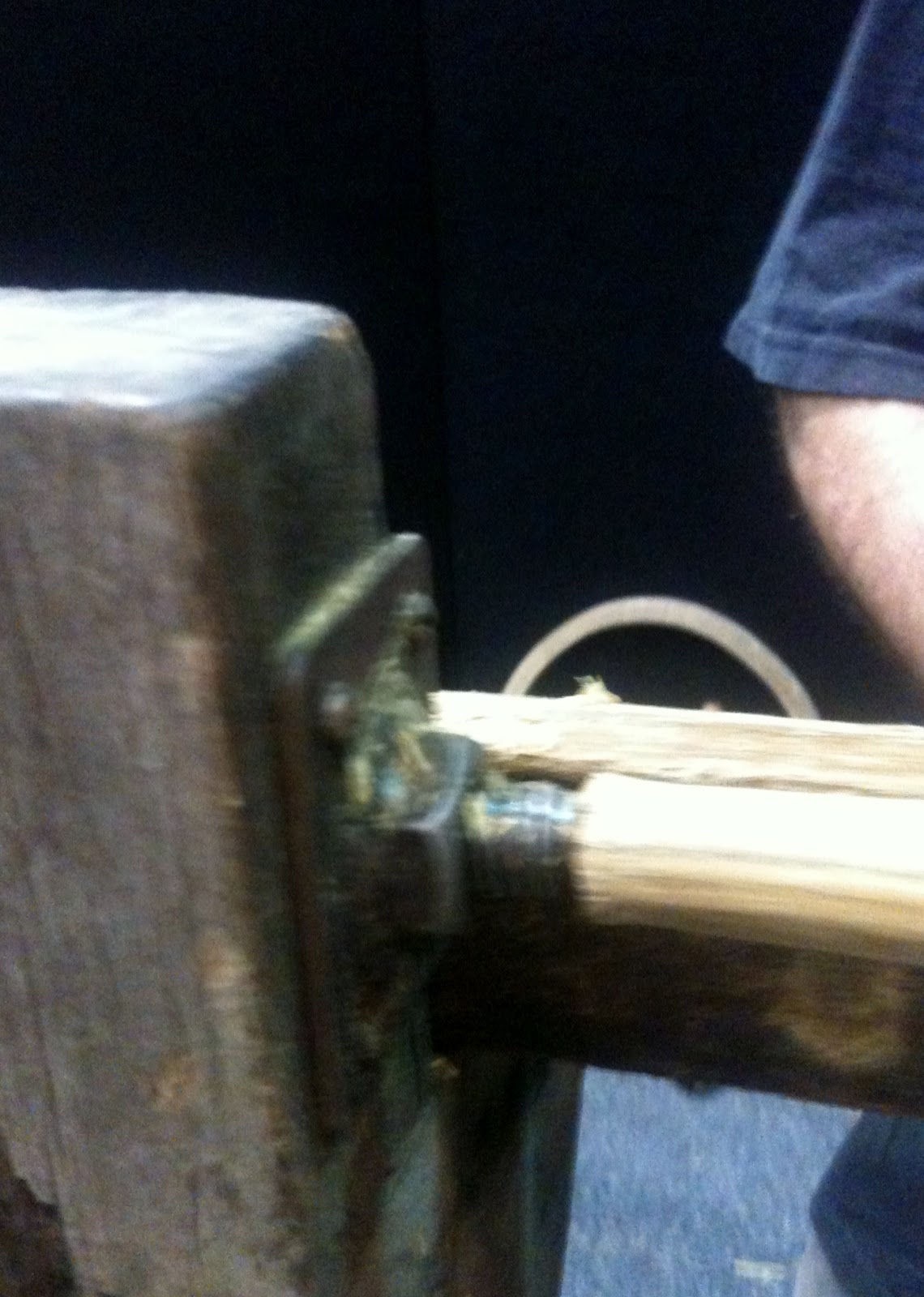
Below are some details of the pole lathe which they use


 This the shaving horse, a dumhead type, One of the chairs is in the background on the left.

I'm considering buying a bowl adze from Henry Eckert. It's $160 and certainly looked like it quality wise. It would make bowl making very easy indeed and I could probably make that money back in a short period of time. I would need to make 16 bowls or so, or charge over $15 a bowl, whih may not be too bad a price. If I can make them work the way I want to, and finish them well. I intend to have a crack at making a big bread raising bowl.
 So overall it was a fun day and has broadened my awareness of all things wood.